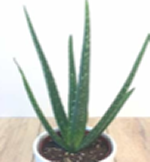
I don’t have a great variety of houseplants but, of the small collection I do have, the best is undoubtedly the Aloe. I actually have 2 varieties of Aloe, Aloe vera with its Spring green toothed leaves and Aloe maculata which has light green speckled leaves, turning pink/brown in full sun. The Aloe vera is the most useful plant I could have as I frequently have to break off a leaf when I burn myself in the kitchen. Inside the fleshy leaves is a clear gel. I squeeze the leaf like a tube of ointment and apply the gel to the burn. If I get there quickly enough the burn does not redden or blister. It never ceases to amaze me how it works.
Aloe belongs to the family of succulents which are greatly in fashion at the moment, partly because they are wonderfully architectural and textured plants, but also because, given the right growing conditions some, but not all, can survive a bit of neglect. They tend to originate from an arid desert-like climate where their fleshy leaves help retain moisture, so it is important to keep them in warmth and sunlight and grow them in a very well-draining soil. Perhaps add some perlite to help with this. The soil should be allowed to dry out completely between watering and when you do give it a drink, drench the plant so that the water runs out of the bottom of the pot. The aim is to emulate the dry desert conditions from their homeland
The succulent of the moment in terms of fashion is the Sempervivum (common name Houseleek or Hens and chickens!). It can be found planted in dense groups in a wall mounted frame or in a terrarium. Both of these methods though can make it difficult for the plant to thrive. I find that it is better to give them a little more space and plant them in a shallow dish (with drainage holes of course). A dressing of small gravel around the plant
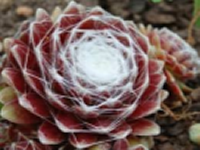
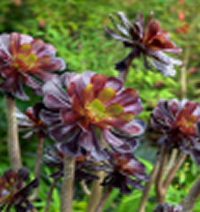
Sempervivum arachnoideum Aloe vera Aeonium Schwarzkopf
The house plant succulents can sit outside in the summer in a grouping of pots, perhaps as a leafy textured contrast to bright coloured annuals or grasses or in the case of the Aeonium Schwarzkopf to give a tropical feel amongst the orange and reds flowers of Cannas.
I use Sempervivums quite a lot in my designs as I love the texture they bring to small flat areas. They are so many different types and colours- from blue/green to bright green, purple and red. Some are soft and furry, some are spiky and the Sempervivum arachnoideum looks like a spider has been busy spinning layers of its web across the top. They all have leaves arranged in a rosette. Echeveria –a blue green succulent which also grows in a rosette- is often mistaken for Sempervivum. However, while the latter can be planted outside in a sunny well drained position, the Echeveria is not hardy and will not survive our cold wet winters.